Last Updated: October 26, 2026
Quick Summary
Professional parking garage cleaning follows a set sequence: document conditions, post signage and a traffic plan, clear loose debris, pre-treat oil and rust stains, surface clean the decks, then recover wash water for proper disposal. A workable baseline for most open-deck garages is a full deep clean once or twice a year, adjusted for climate, traffic, surface type, and drainage.
- De-icing salts dissolve into chloride-laden water that corrodes reinforcing steel and spalls concrete from the inside.
- Crews capture wash water with storm drain protection, berms, and vacuum recovery for compliant wastewater disposal.
- Epoxy coatings need low to moderate pressure and mild degreaser to avoid lifting the finish at edges.
- High-traffic facilities benefit from quarterly attention to ramps, entrances, drive aisles, and elevator lobbies.
- A bid that omits water recovery is not comparable to one that includes it.
Table of Contents
- Why Commercial Parking Garage Cleaning Protects the Asset and the Bottom Line
- Parking Garage Cleaning Equipment: What a Professional Crew Brings
- Step-by-Step Commercial Parking Garage Cleaning Process
- Surface-Specific Cleaning: Epoxy, Concrete, and Asphalt
- Environmental Compliance and Wastewater Disposal Rules
- Parking Garage Cleaning Frequency: How Often Is Enough?
- Parking Garage Maintenance Checklist for Facility Managers
- Parking Garage Cleaning Cost: What Drives the Price
- Frequently Asked Questions
Why Commercial Parking Garage Cleaning Protects the Asset and the Bottom Line
De-icing salts carried in on tires dissolve into chloride-laden water that seeps into pores and cracks, corroding the reinforcing steel beneath.
Clean decks keep slip and fall prevention credible, protect structural integrity, and preserve curb appeal.
If you are weighing whether to bring in a crew, commercial pressure washing service can cover garage cleaning, from deck washing to runoff capture.
Parking Garage Cleaning Equipment: What a Professional Crew Brings
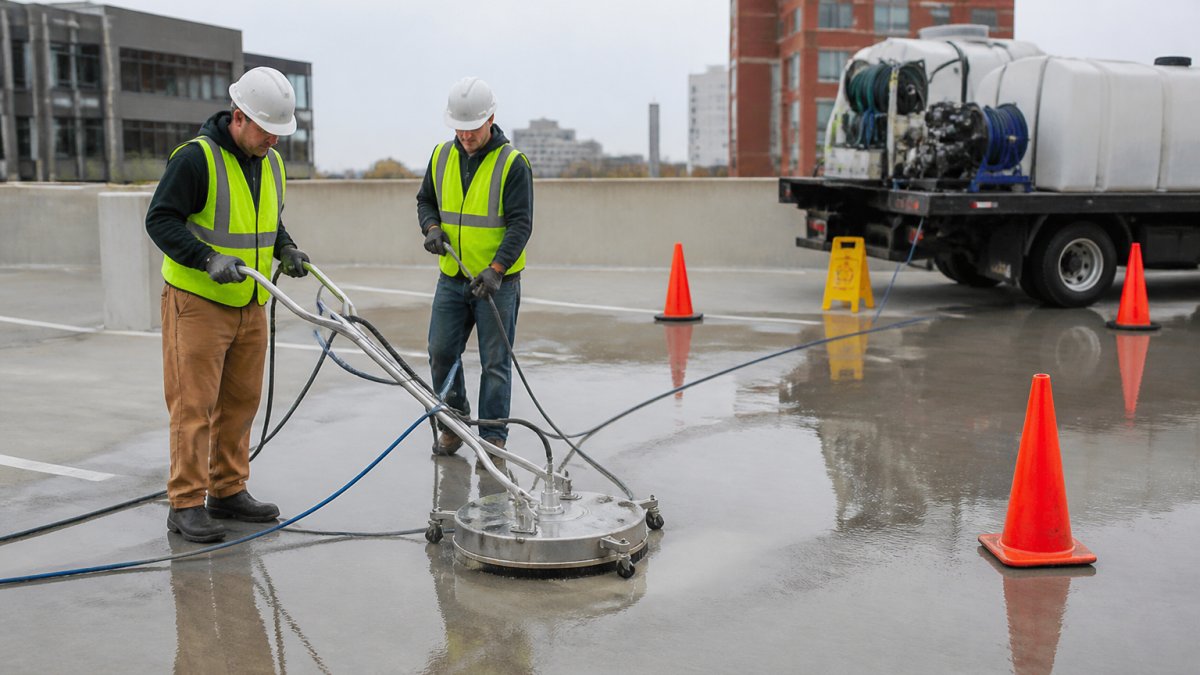
A serious operation brings truck-mounted equipment built for volume: high-flow pressure washing units, walk-behind and ride-on surface cleaners, and recovery tanks sized for the job. A garden hose and borrowed pressure washer will not cut it.
Parking garage cleaning equipment falls into a few working categories:
- Truck-mounted pressure washing units with heated water for cutting grease and oil
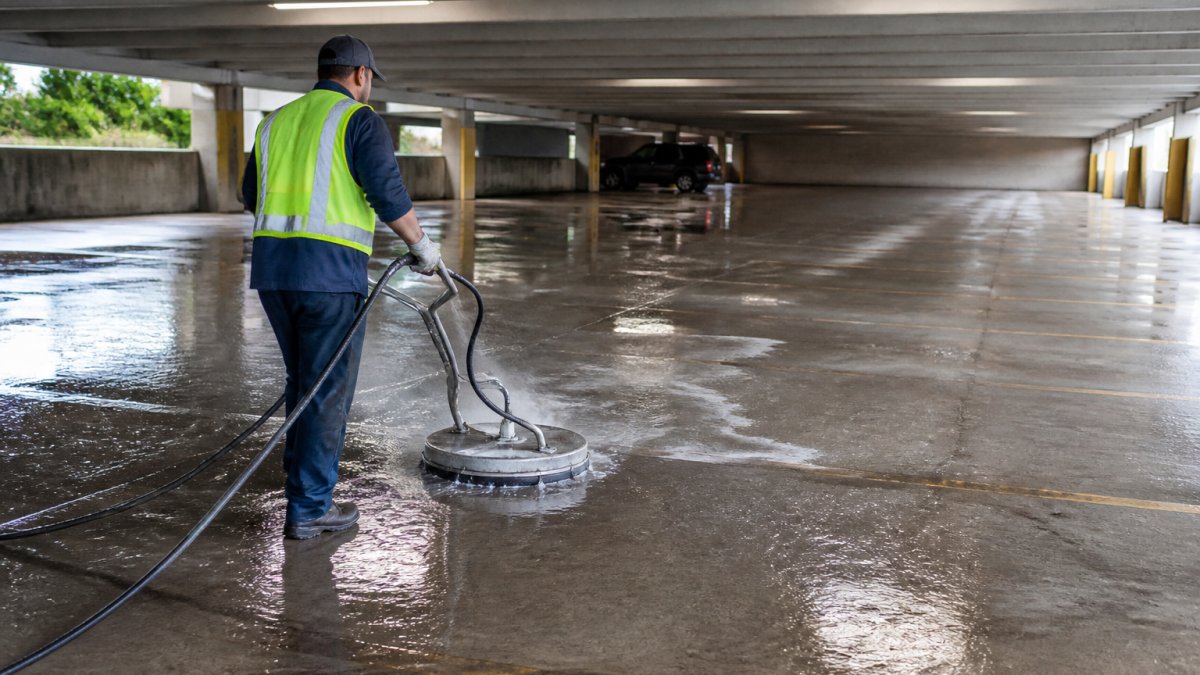
- Surface cleaners that spin a high-pressure bar under a shroud for even, streak-free passes
- Backpack blowers for moving loose debris before any water touches the deck
Pressure Washing and Surface Cleaners for Concrete Decks
A wand alone is slow and uneven. Surface cleaners cover a wide path with consistent pressure, which matters on a parking structure where a streaked deck looks worse than a dirty one. Heated water and an industrial degreaser lift oil films that cold water just pushes around, and matching pressure to the surface prevents etching.
Water Reclamation and Storm Drain Protection Gear
Every gallon that hits the deck has to go somewhere, and it cannot simply run into a storm drain. Crews deploy storm drain protection covers, berms, and vacuum recovery systems to capture wash water and pump it into holding tanks for proper wastewater disposal. That water reclamation keeps a cleaning job compliant rather than a violation waiting to be written up.
Step-by-Step Commercial Parking Garage Cleaning Process
Most jobs follow a predictable sequence that protects workers, the surface, and the drainage system.
- Walk the structure and document conditions. Note cracks, spalling, existing stains, and drain locations before anything gets wet.
- Post signage and set the traffic plan. Cones, barriers, and clear safety signage go up before equipment rolls in.
- Clear loose debris. Blowers and manual pickup remove grit, leaves, and trash so it does not clog drains or turn into slurry.
- Pre-treat stains. Oil, rust, and gum get targeted treatment with degreasers or surfactants and dwell time.
- Surface clean the decks. Walk-behind cleaners make even passes, working from the top level down.
- High-pressure rinse and recover water. Wash water is captured, not flushed.
- Clean drains and containment areas. Grates, catch basins, and drain filtration get cleared and checked.
- Inspect and document. A post-clean walk confirms results and flags damage for repair.
For fleets and lots tied to the same properties, fleet washing services often run alongside garage work.
Traffic Management and Safety Signage During Cleaning
Cleaning a working garage means cleaning around cars and people. A solid traffic management plan closes one section at a time, keeps a clear path for pedestrians, and uses cones, barriers, and signage to route drivers away from wet decks and equipment. Sequencing bay by bay limits operational downtime.
Debris Removal, Drain Maintenance, and Oil Stain Remediation
Debris removal comes first because grit and leaves clog drains faster than anything else; clearing catch basins and trench drains before washing prevents backups that can flood a deck. Oil stain remediation is its own step: fresh oil lifts with degreaser and agitation, while older, soaked-in stains may need repeated treatment. Rust and mineral streaks near expansion joints and drains need dedicated treatment, which can be handled with rust stain removal.
Surface-Specific Cleaning: Epoxy, Concrete, and Asphalt
Not every deck wants the same treatment. Epoxy coatings are the most delicate: too much pressure or the wrong cleaner dulls the finish and can lift the coating at edges. Concrete tolerates higher pressure and stronger degreasers, though sealed concrete still needs care. Asphalt tops out at lower pressure and cooler water, since heat and pressure can soften the binder and dislodge aggregate. Concrete sealing after cleaning extends the life of all three surfaces, and our concrete cleaning work matches method to material.
| Surface | Pressure Level | Watch Out For | Best Approach |
|---|---|---|---|
| Epoxy coating | Low to moderate | Coating lift at edges, dulling | Soft wash, mild degreaser |
| Sealed concrete | Moderate | Etching, seal damage | Surface cleaner, controlled heat |
| Bare concrete | Moderate to high | Spalling at cracks | Heated water, degreaser |
| Asphalt | Low, cooler water | Binder softening, aggregate loss | Reduced pressure, gentler rinse |
Environmental Compliance and Wastewater Disposal Rules
Wash water from a garage is not clean water. Many municipalities publish their own stormwater guidance, and the EPA’s stormwater program sets the framework those rules build on: EPA stormwater program overview.
Ask any contractor how they handle runoff before you hire them. A crew that lets wash water run into a drain creates liability for the property owner, not just the contractor.
Parking Garage Cleaning Frequency: How Often Is Enough?
Parking garage cleaning frequency is not a single number. It is a schedule built from four inputs: climate exposure, traffic volume, surface type, and drainage and condition. A workable baseline for most open-deck garages is a full deep clean once or twice a year, but that baseline shifts hard in either direction.
The Four Inputs That Set the Schedule
**1.
2. Traffic volume and vehicle mix. A garage turning over hundreds of cars a day accumulates oil drips, tire marks, and gum far faster than a low-turnover tenant lot.
3. Surface type and coating condition. Epoxy-coated decks show wear and dulling faster than bare concrete and need gentler, more frequent cleaning to avoid coating failure.
4. Drainage and standing water. A garage with chronic low spots, clogged catch basins, or poor slope needs more frequent debris removal and drain clearing regardless of how clean the decks look.
A Practical Frequency Framework
| Condition | Minimum Full Clean | High-Wear Spot Attention |
|---|---|---|
| Cold-weather region, heavy salt, high traffic | 2x per year (post-winter + pre-winter) | Quarterly |
| Cold-weather region, moderate traffic | 1-2x per year | Semiannual |
| Warm/dry climate, high traffic | 1-2x per year | Quarterly |
| Warm/dry climate, low traffic | 1x per year | Annual |
| Epoxy-coated decks (any climate) | Per coating manufacturer guidance, often 2x | Quarterly inspection |
| Chronic drainage issues | Add debris/drain clearing between full cleans | Monthly drain check |
Treat the table as a starting point, not a prescription. The right cadence comes from a walkthrough that documents staining, spalling, joint condition, and drain performance.
Signs You Are Overdue
- Visible oil sheen or dark staining across decks
- White salt haze or rust streaks near drains and expansion joints
- Standing water that lingers more than a day after rain
Why the Calendar Beats the Reaction
Frequency is a preventative maintenance decision, not a response to how bad things look. Chloride corrosion and freeze-thaw damage progress beneath a surface that can still look acceptable, so a garage cleaned on schedule stays ahead of the damage curve while one cleaned only when it looks bad is already paying for deferred work.
Photograph the same three or four locations (a ramp, an entrance, a drain, and a low spot) on every visit. The photo record is the fastest way to see whether your frequency is actually keeping up with wear.
Parking Garage Maintenance Checklist for Facility Managers
Use this parking garage maintenance checklist to track condition between professional cleanings and to brief a contractor.
- Walk all levels and photograph cracks, spalling, and stains
- Check expansion joints for separation or debris
- Clear catch basins, trench drains, and grates
A short monthly walk catches small problems before they become structural ones. The checklist is the record that tells you whether your maintenance program is working.
Parking Garage Cleaning Cost: What Drives the Price
Parking garage cleaning cost is driven by square footage, level count, surface type, stain severity, access, and, the variable most guides ignore, how the wash water is handled. Here is the framework to estimate scope, compare bids, and decide whether to keep the work in-house or outsource it. To request a quote for commercial garage cleaning, contact us.
The Cost Drivers, in Order of Impact
- Cleanable square footage and level count. Deck area is the primary multiplier. Multi-level structures add ramp and stairwell cleaning, more equipment moves, and more traffic control per job.
- Surface type and coating condition. Epoxy and sealed decks require lower pressure, milder chemistry, and more care, adding labor time. Heavily worn coatings may need resealing after cleaning.
- Stain severity. Light soil is a straightforward surface clean. Heavy oil, rust, and gum require pre-treatment, dwell time, and sometimes repeat passes, the biggest swing factor on labor hours.
How to Read a Bid
When you compare quotes, normalize them on these points so you are comparing scope, not just totals:
- Is water recovery included? If not, the contractor is either planning to discharge to a storm drain (a compliance risk for the property) or will add it later.
- What pressure and chemistry are specified per surface? A bid that treats epoxy and bare concrete the same is a red flag.
- Is stain treatment itemized or lumped in? Lumped-in stain work often means a generic pass, not targeted remediation.
- What is the traffic control plan? Section closures, signage, and pedestrian routing should be described, not assumed.
- What does the post-clean walk include? A documented inspection with photos is worth more than a verbal “looks good.”
- What is excluded? Drain repair, joint sealing, and coating restoration are commonly excluded and should be identified up front.
DIY Versus Professional: A Decision Framework
Whether an in-house team can handle garage cleaning depends on volume, equipment, and compliance exposure.
In-house makes sense when:
- The garage is small (a single level or a limited deck area) and low-traffic.
- You already own or can justify a commercial pressure washer and wet/dry vacuum.
- Staining is light and surfaces are forgiving (bare concrete).
Professional service makes sense when:
- The structure is multi-level or high-traffic, where equipment throughput and traffic sequencing determine whether the job finishes on schedule.
- Decks are epoxy-coated or sealed and require surface-specific pressure and chemistry.
- Oil, rust, or gum staining is significant and needs targeted remediation.
The real comparison is total cost of ownership: equipment depreciation, water and disposal handling, worker training and safety, compliance risk, and the opportunity cost of pulling your team off other work. A low in-house number that ignores recovery equipment and disposal is not a real number.
A bid that is dramatically lower than the others usually differs in one of three places: water recovery, surface-specific care, or stain treatment. Ask which one was cut before you sign.
Frequently Asked Questions
How often should a commercial parking garage be cleaned?
Most parking structures benefit from a deep cleaning two to four times per year, with high-traffic decks and entry areas on the more frequent end. Daily litter pickup and periodic spot treatment for oil stains keep the surface presentable between full cleanings. Climate matters too: regions that spread de-icing salts in winter should schedule a thorough rinse in early spring to flush residue before it works into the concrete.
What equipment is used to clean a parking garage?
A professional crew typically brings truck-mounted pressure washing units, walk-behind surface cleaners, industrial degreasers, and backpack blowers for debris. Water reclamation equipment, including containment berms and vacuum recovery systems, captures runoff before it reaches storm drains. Traffic cones, safety signage, and sometimes scrubbing machines round out the setup. The right parking garage cleaning equipment depends on deck size, surface type, and local wastewater rules.
Can you pressure wash a garage floor without damaging it?
Yes, when pressure and nozzle choice match the surface. Concrete handles higher pressure well, but epoxy coatings and sealed decks need lower pressure and wider spray angles to avoid lifting the finish. A surface cleaner attachment keeps the spray even and reduces streaking. Avoid directing high-pressure rinsing at expansion joints, drains, or deteriorated patches, where water can get underneath and worsen damage.
How is wastewater from parking garage cleaning handled?
Wastewater from parking garage cleaning cannot go straight into storm drains in most jurisdictions because it carries oil, grease, and sediment. Crews collect it with containment berms and vacuum recovery units, then dispose of it through a permitted wastewater disposal service or an approved sanitary sewer connection, depending on local rules. Confirm the disposal method with your cleaning contractor before work begins.
What drives parking garage cleaning cost?
Parking garage cleaning cost depends on square footage, number of levels, surface type, stain severity, and access restrictions. Structures with heavy oil staining or tight clearance for equipment take longer and cost more. Water reclamation requirements and after-hours scheduling also affect the quote. Because pricing varies so much by site, request a walkthrough and written estimate rather than relying on a per-square-foot rule of thumb.
How do you remove oil stains from a concrete parking garage floor?
Oil stain remediation starts with absorbing fresh residue, then applying an industrial degreaser and letting it dwell before scrubbing and rinsing. Older, set-in stains may need repeated treatments or a poultice to draw the oil out of the concrete pores. Cleaning while the stain is fresh always gets better results. After cleaning, a concrete sealer slows future absorption and makes the next cleanup easier.


Comments are closed